ChatGPT, Gemini, Perplexity and Claude: how does optimization differ for each?
“Optimize for AI” sounds like one task, but ChatGPT, Gemini, Perplexity and Claude answer questions in different ways. It pays to know how they differ before deciding where to put your effort.
What all four have in common
ChatGPT, Gemini, Perplexity and Claude are large language models. Each learned from a huge body of text and was then fine-tuned to answer helpfully and follow instructions. That is why good GEO practice is similar for all of them: a concrete page about the company, content that answers customer questions, and confirmation in independent sources. You will find the details in our guide to SEO for AI.
The differences begin when a model answers a specific question. An answer can come from three places: knowledge “stored” in the model during training, search results fetched at the moment of the question, or the user’s own data (emails, documents). How often each is used depends on the product, not just on the model itself.
An important caveat
OpenAI, Google, Perplexity and Anthropic do not disclose exactly how they pick sources, and the systems change without notice. The descriptions below are a simplified picture based on what the companies say publicly and on tests we run ourselves. Treat them as a rough map and check against your own questions (the 15-minute test).
The comparison at a glance
| Engine | Where the answer comes from | What usually works |
|---|---|---|
| Perplexity | Live search, every answer with sources | Fresh, concrete content that can be quoted in one sentence |
| ChatGPT | Model knowledge plus search when the question needs it | Presence across many sources, rankings, reviews, brand mentions |
| Gemini | Model plus Google’s index and data | Solid SEO, structured data, Google Business Profile, consistent company data |
| Claude | Model knowledge and web search where enabled | Content with depth and sound reasoning, clear authorship |
The table is a simplification. Product features change often, and the same question in different plans and apps can follow a different path.
Perplexity: a search engine that answers
Perplexity is built around search and citation. Every answer carries footnotes, so you can see which pages were used. That is good news for you: you can inspect the sources and see exactly what your page is missing. What helps:
- concrete, self-contained sentences that can be lifted out of context without losing meaning (numbers, definitions, prices, ranges),
- freshness: an update date and regular refreshes of important pages,
- your own data and examples from real projects, because generalities are hard to quote.
ChatGPT: the largest audience, many sources at once
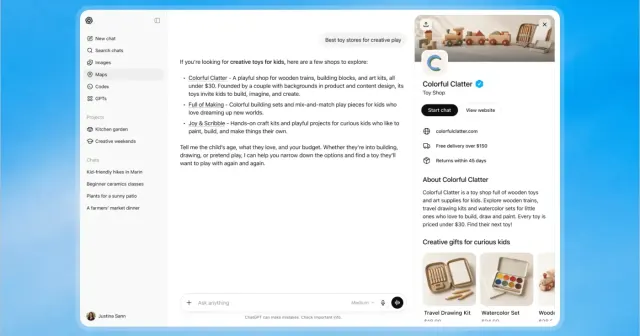
ChatGPT has the most users, so it is usually where the work starts. It answers partly from model memory, and when a question needs current information (recommendations, comparisons, prices) it runs a search. In practice, which companies get chosen depends on how often and in what context the brand appears in different places online: your own site, rankings, trade media, reviews. We cover this mechanism in more detail in the piece on query fan-out.
Gemini: the Google ecosystem
Gemini and Google’s AI Overviews draw on the infrastructure Google knows best: the search index, business listings, maps, structured data. That is why classic SEO and tidy company data have the biggest effect here: consistent NAP (name, address, phone), a complete Google Business Profile, correct structured data (Organization, LocalBusiness, FAQPage) and a strong, indexed website. A page Google does not index will have a hard time being recommended in Gemini.
Claude: depth and rigor
Claude is often used for longer work: analysis, writing, code. Where it has web search, it pulls sources much like the others. In our observation, content with clear structure, a named author and reasoning does well: a concrete method, first-hand experience, results with context. Shallow, recycled text rarely stands a chance.
Turning this into a plan
- Foundation first, shared by all: a page about the company, content answering customer questions, structured data, mentions in independent places.
- Check where your customers are. Local and service businesses often start with ChatGPT and Gemini, e-commerce and B2B with ChatGPT and Perplexity.
- Measure each engine separately. A result in ChatGPT says nothing about Gemini. Use the same set of questions and record presence, position and cited sources.
- Repeat the tests every month. Product changes are frequent and worth catching.
If you are unsure where to start, 7 steps to get recommended by ChatGPT is a good starting point, and we describe the results of this kind of work in the MOL case study.
Frequently asked questions
Do ChatGPT, Gemini, Perplexity and Claude use the same algorithm?
No. All rely on language models, but each product combines model knowledge with search differently and picks sources differently, so the same company can be recommended in one assistant and not in another.
Which AI assistant should I start with?
The one your customers use. In most industries it makes sense to start with ChatGPT and Gemini, and add Perplexity where customers compare a lot and look for sources.
Do I need separate optimization for each assistant?
Most of the work is shared: a clear company description, content answering questions and mentions in external sources. The differences are mostly in priorities and in how you measure.